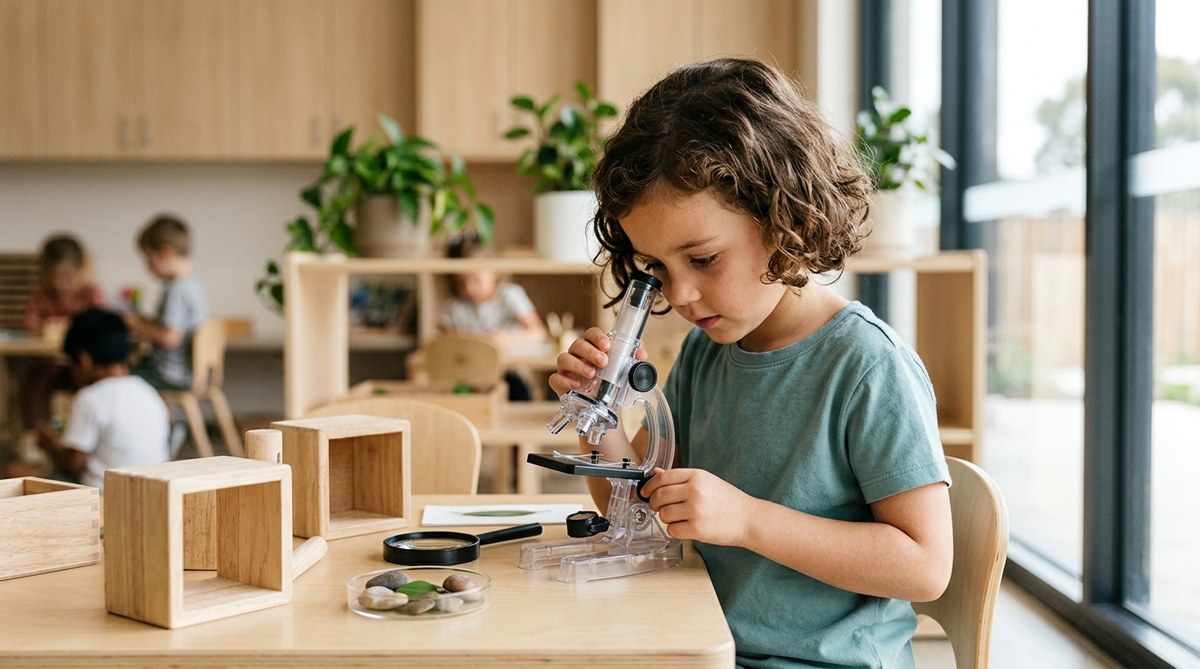
Imagine a learning journey where children pursue questions that matter to them, choose tasks that fit their interests, and grow confident through steady discovery. Self directed learning is not just a trend in education; it is a scientifically supported approach that aligns with how young minds develop. At Montessori Scientific Research, we explore how self directed learning combines the freedom to explore with the support of a carefully designed environment. The result is deeper engagement, stronger problem solving, and a foundation for lifelong learning. In this article we unpack what self directed learning means for children, why science backs it, and practical steps to bring these ideas into homes and classrooms.
What is Self Directed Learning and Why It Matters
Self directed learning is a teaching and learning approach in which children take the lead in setting goals, choosing activities, and steering their own path toward understanding. It is not unstructured free play, nor is it random exploration. It is intentional, reflective, and scaffolded by supportive adults who provide resources, guidance, and feedback.
Defining the core elements
- Autonomy with guidance: Children make choices within a structured environment that offers clear boundaries and meaningful materials.
- Intrinsic motivation: Learning is driven by curiosity and personal relevance rather than external rewards.
- Inquiry based learning: Questions lead the way, and students pursue evidence, experiments, and solutions.
- Reflection and iteration: Learners review what worked, adjust strategies, and persist through challenges.
- Responsible independence: Children practice planning, time management, and self-regulation.
Why it matters for children
Science across developmental domains indicates that when children direct aspects of their learning, they develop better executive function, improved problem solving, and deeper understanding. They also become more resilient and capable of adjusting to new tasks, which is essential in a rapidly changing world.
The Science Behind Self Directed Learning for Children
Brain development and executive function
Young brains are wired to learn by actively engaging with their environment. When children choose tasks and set goals, they practice planning, monitoring progress, and adjusting strategies. This repeated practice strengthens executive functions such as working memory, cognitive flexibility, and inhibitory control. In practice, these skills translate into better focus, more adaptive thinking, and a greater ability to manage complex tasks over time.
Motivation, curiosity, and deep learning
Autonomy fuels intrinsic motivation. When children feel ownership over their learning, they are more likely to invest time and effort, even when the topic is challenging. Curiosity becomes a self-sustaining cycle: questions lead to experiments, which produce evidence, which in turn generates new questions. This cycle cultivates a love of learning rather than a habit of racing through tasks for grades.
Social emotional benefits
Self directed learning often involves collaboration, negotiation, and shared decision making. Children practice communication, perspective taking, and empathy as they navigate group tasks and feedback from peers and adults. The result is not only stronger academic outcomes but also healthier social and emotional development.
Long term outcomes
Over time, learners who regularly engage in self directed learning tend to transfer skills beyond specific subjects. They graduate with better self-regulation, more flexible problem solving, and a mindset oriented toward lifelong growth. These outcomes align with the modern world’s needs for adaptable, self-motivated, and reflective thinkers.
How Montessori Supports Self Directed Learning
Montessori education has long championed child led inquiry within a prepared environment. Many of the features that make Montessori effective for self directed learning are also supported by contemporary research on independent learning and development.
Prepared environment and accessible materials
The classroom is arranged to invite exploration. Materials are organized by purpose, accessible at the child’s height, and chosen to scaffold progress from concrete to abstract. This readiness for self directed activity reduces friction and invites children to engage, experiment, and repeat as needed.
Hands on materials and guided discovery
Manipulatives and sensory materials allow children to test ideas physically before moving to more abstract reasoning. Through guided discovery, teachers observe, ask guiding questions, and provide just enough assistance to keep the learner moving forward without dominating the process.
Choice within meaningful structure
Even within a structured environment, Montessori students choose what to work on, how long to engage, and when to switch tasks. The balance of freedom and structure supports sustained attention, perseverance, and deeper involvement with learning activities.
Mixed age classrooms and peer learning
Older students model strategies and younger peers benefit from exposure to varied approaches. Peer teaching and collaboration support communication skills and expose children to multiple perspectives, reinforcing the idea that learning is a collaborative journey.
Observation, documentation, and reflection
Educators observe child led activities to identify interests, strengths, and growth areas. Documentation helps families see progress and supports ongoing planning for next steps. Reflection sessions encourage learners to articulate what they learned and what they would like to explore next.
Practical Ways to Foster Self Directed Learning at Home and School
Creating an environment that supports self directed learning requires thoughtful choices about space, routines, materials, and interactions.
For parents at home
- Build interest driven projects: Start with a question your child cares about. Offer a range of materials and space to explore. Allow time for experimentation and revision.
- Use learning menus and choice boards: Provide options across subjects and formats. Let children pick items they want to tackle during a dedicated block of time.
- Establish flexible routines: Routines provide predictability without stifling curiosity. Include a regular project time, a quiet reflection period, and opportunities for outdoor exploration.
- Integrate real life tasks: Cooking, shopping, gardening, or repairing something at home offer authentic contexts for problem solving and decision making.
- Encourage reflection: End sessions with a brief conversation about what worked, what did not, and what the next step could be.
For educators in classrooms
- Balance facilitation and instruction: Guide students with questions rather than simply presenting facts. Teach strategies for researching, testing, and evaluating evidence.
- Design inquiry based lessons: Present a puzzle or scenario and give students room to explore multiple approaches.
- Create a prepared environment: Ensure materials are organized, accessible, and clearly labeled. Provide spaces for individual work and collaborative projects.
- Use student led conferences and check ins: Allow students to present their learning journeys to peers and teachers, fostering accountability and pride in their work.
- Incorporate portfolios: Collect work across weeks to show growth, reflect on strategies, and plan for future inquiries.
Signs Your Child is Ready for Self Directed Learning
Recognizing readiness helps families and teachers start with appropriate supports rather than forcing a transition.
- They ask questions and pursue topics beyond what is assigned.
- They demonstrate sustained interest in a topic and engage in extended investigations.
- They enjoy hands on exploration and prefer manipulating materials to listening to long lectures.
- They set goals and monitor progress with minimal prompting.
- They demonstrate intrinsic motivation and show initiative to complete tasks without reminders.
Practical readiness checks
- Observe how they choose activities at a library, museum, or school.
- Note whether they plan a sequence of actions for a project and adjust as needed.
- Assess their comfort with collaboration and sharing ideas in small groups.
Common Challenges and How to Overcome Them
Self directed learning is highly rewarding but can present challenges. Addressing them with structure and support helps children build resilience.
- Impulsivity and frustration: Teach self regulation strategies such as breathing, chunking tasks, and taking short breaks. Scaffold through gradually increasing task complexity.
- Time management: Help children estimate how long a task will take, create a timeline, and set interim milestones.
- Choice overload: Offer curated options in learning menus and rotate materials so choices remain meaningful.
- Misalignment between home and school: Maintain open communication with educators to harmonize expectations, materials, and routines.
- Screen time balance: Use digital tools intentionally, with clear learning goals and reflective discussions about outcomes.
Measuring Progress in Self Directed Learning
Assessment in a self directed framework emphasizes growth, process, and reflection rather than only outcomes.
- Portfolios: A collection of work over time that demonstrates thinking, problem solving, and skill development.
- Self assessment rubrics: Simple scales where children evaluate their own effort, strategy, and understanding.
- Reflective journaling: Short written or drawn reflections about what was learned, what remains unclear, and what to try next.
- Observational records: Educators and parents note behaviors such as persistence, collaboration, and use of strategies.
- Performance tasks: Real world tasks that require applying multiple skills and demonstrating understanding.
Case Examples to Illustrate Concepts
- Case 1: Local ecology project leads a child from identifying a question about a park ecosystem to designing a simple investigation, collecting data, and presenting findings to peers.
- Case 2: A math exploration with manipulatives evolves into an inquiry about patterns and relationships, leading to a self created mini project that integrates measurement and spatial reasoning.
- Case 3: A reading based inquiry prompts a child to assemble a small research notebook, test hypotheses about authorial intent, and share conclusions with family during a weekly reflection time.
Myths About Self Directed Learning
- It means no guidance: In fact it depends on expert facilitation, carefully designed environments, and timely feedback to steer learning without taking control away from the learner.
- It is only for gifted students: Self directed learning benefits a wide range of learners because it emphasizes individualized interests, pacing, and supports diverse strengths.
- It is chaotic and unstructured: The structure of the environment and the scaffolds in place create a predictable, safe space in which curiosity can flourish.
Why This Approach Aligns with Montessori Science
- Autonomy and respect for individuality: Children are treated as capable agents with unique interests and abilities.
- Hands on learning with a concrete to abstract progression: Learning materials are chosen to support tangible understanding before moving to symbolic reasoning.
- A strong emphasis on environment as teacher: The prepared environment is designed to invite exploration and self regulated learning.
- Observation as a learning tool: Teachers watch to understand needs, not to control the process.
Resources and Further Reading
- Foundational Montessori texts on prepared environments and child led learning
- Cognitive development research on executive function and self regulation
- Studies on inquiry based learning, project based learning, and long term outcomes
- Parenting and teaching guides that emphasize reflective practice and portfolio assessment
If you are a parent or an educator seeking to align learning with how children naturally explore the world, self directed learning offers a powerful framework. It is not a single method but a philosophy supported by science and enriched by Montessori practice. By combining child led inquiry with a thoughtfully prepared environment, you create opportunities for children to build independence, cultivate curiosity, and develop the problem solving and collaboration skills that matter most in life.
Appendix: Quick Start Checklist
- Create a welcoming space with accessible materials labeled clearly
- Develop a flexible daily block dedicated to self directed inquiry
- Prepare at least two learning menus each week with diverse topics
- Schedule regular reflection moments for learners to voice what they learned and what they want next
- Keep portfolios and progress notes to track growth over time
- Communicate with families about ongoing inquiries and progress
A final note from Montessori Scientific Research: The science behind self directed learning is still growing, but the consensus is clear. When children take the lead in their learning, supported by a rich environment and thoughtful facilitation, they become more capable, resilient, and lifelong learners. Our site continues to explore these connections, offering practical guidance and evidence based insights for educators and parents who want to cultivate independent, motivated, and curious young people.