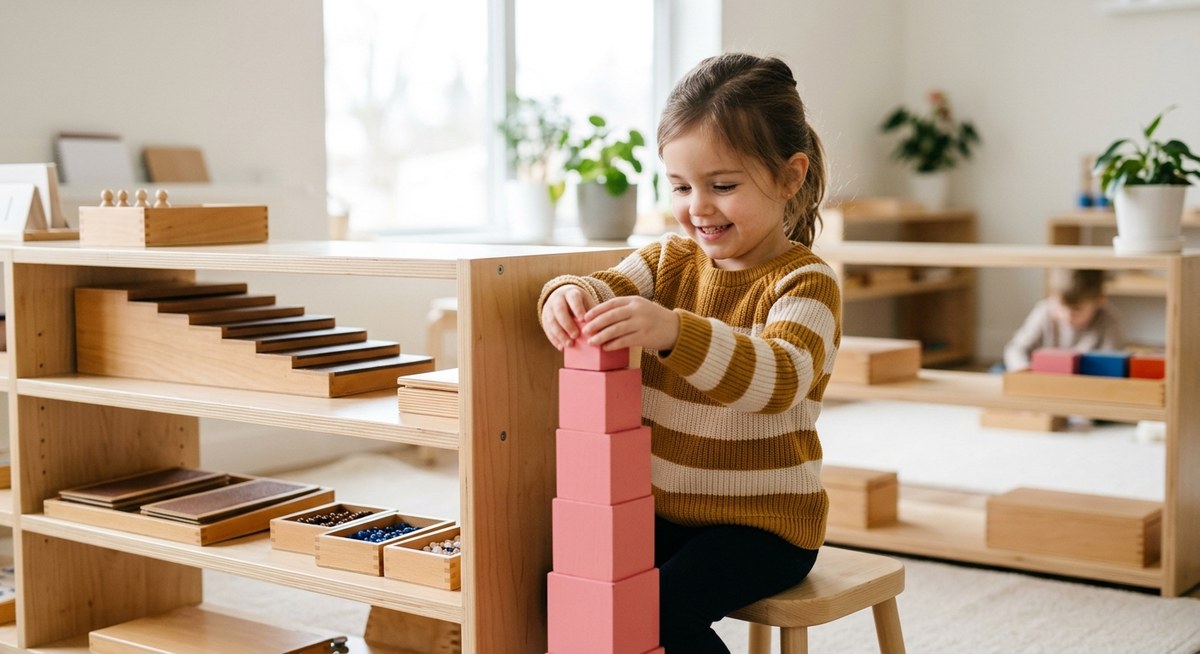
From the moment a young child begins to explore the world, the brain is hard at work forming connections, pruning neural pathways, and learning how to regulate attention, emotions, and movement. Montessori methods offer a thoughtful, science aligned approach to early learning that respects both the pace of the child and the biology of growing minds. At Montessori Research and Studies, we examine how concrete materials, self directed learning, and a carefully prepared environment align with what contemporary neuroscience and child development research tell us about how brains grow best in the early years. In this article we will unpack the key ideas behind Montessori pedagogy, translate them into brain friendly practices, and provide practical guidance for parents and educators who want to support lifelong learning from the first years of life.
The Brain in Early Childhood: What Science Says
In early childhood the brain is exceptionally plastic, meaning experiences can strongly shape its architecture. Several core science concepts help us understand why Montessori methods can be powerful in practice.
- Neuroplasticity drives learning: Repeated, meaningful experiences strengthen neural connections. When children engage in purposeful tasks, they build more robust networks for memory, attention, and problem solving.
- Sensory integration matters: The developing brain uses multiple senses to interpret the world. Rich, multisensory experiences help create integrated representations that support later cognitive tasks such as reading and math.
- Executive function emerges early: Working memory, cognitive flexibility, and inhibitory control begin to develop in toddler and preschool years. Activities that require attention and deliberate practice of self regulation foster these skills.
- Repetition and mastery support confidence: Repeating meaningful actions helps children move from concrete actions to mental representations, supporting procedural memory and smooth progression into abstract thinking.
- Social and emotional context matters: Positive relationships and safe, predictable routines provide a neural environment in which learning can thrive. Emotional regulation and social competence support cognitive processing.
Understanding these ideas helps illuminate why Montessori environments, with their emphasis on choice, routine, and hands on materials, can be particularly conducive to healthy brain development in the earliest years.
Montessori Principles at Work in Brain Development
Montessori education is built around foundational principles that echo what neuroscience says about optimal early learning. Here is how these principles map onto brain development in practice.
Self-Directed Learning and Intrinsic Motivation
- Children engaging in tasks they choose themselves tend to show increased attention span and task persistence.
- Autonomy supports the development of intrinsic motivation, a key driver of sustained learning and the ability to tackle challenging problems.
Mixed-Age Classrooms and Peer Learning
- Mixed-age groups offer natural opportunities for mentorship, social navigation, and observational learning.
- Younger children benefit from seeing older peers model concentration and careful technique, while older children consolidate knowledge by teaching others.
The Prepared Environment and Uninterrupted Work Periods
- A well organized, predictable environment reduces cognitive load, allowing the brain to allocate resources to learning rather than logistics.
- Uninterrupted work periods give children time to reach deeper states of concentration, a crucial step in building sustained attention.
Concrete to Abstract Learning and Montessori Materials
- Hands on materials translate abstract ideas into tangible experiences, supporting memory and comprehension.
- The progression from concrete manipulatives to abstract reasoning aligns with how the brain builds schemas and conceptual networks.
Respect for the Individual and Freedom Within Limits
- Recognizing each child’s pace and interests supports optimal neural development by reducing stress and promoting curiosity.
- Clear boundaries provide safety signals that help regulate the brain’s stress response systems, enabling more effective learning.
Sensory Richness and Fine Motor Practice
- Sensorial materials engage multiple brain regions, promoting cross modal integration and precise motor control.
- Fine motor activities lay down the neural groundwork for later academic tasks such as writing.
Independence, Confidence, and Social Emotional Skills
- Solving problems independently builds self efficacy, which strengthens motivation and resilience.
- Social learning opportunities foster cooperative behavior and conflict resolution, which in turn modulate emotional circuitry.
The Science Behind Montessori: Key Research Findings
While each study in early childhood development has its own specifics, several recurring themes connect Montessori practice with brain development research.
- Self-directed, child led activities are associated with improved attention regulation and executive function.
- Hands on, multi sensory materials support robust neural networks linking perception, action, and reasoning.
- Mixed-age groups can promote observational learning and social cognitive skills that support later academic achievement.
- A prepared environment that fosters independence reduces cognitive load and supports longer, focused engagement with tasks.
In practice, educators and researchers find that when a child can choose a meaningful activity, see a clear sequence of steps, and work in a quiet, organized space, the brain is better positioned to form durable connections. This is the foundation for cognitive growth that extends beyond early childhood into later schooling.
Practical Applications for Educators and Parents
Whether you are guiding a classroom or supporting learning at home, the following practices translate Montessori theory into brain friendly actions.
- Create a prepared environment
- Materials are accessible and clearly labeled.
- Routines are predictable, with consistent times for work, rest, and meals.
-
The space is quiet enough to promote focused attention but not so silent that it feels oppressive.
-
Observe and respond to interests
- Note what activities captivate a child and gently provide related materials to deepen engagement.
-
Allow time for child initiated exploration before stepping in with guidance.
-
Promote uninterrupted work periods
- Schedule blocks of independent work that are long enough for the child to enter a state of flow but not so long as to cause frustration.
-
Minimize unnecessary interruptions during these blocks.
-
Use concrete materials to build abstract thinking
- Begin with tangible activities that demonstrate a concept before introducing symbols or notation.
-
Gradually increase complexity only after mastery of the current level.
-
Encourage independence and responsibility
- Provide opportunities for self care and daily living tasks.
-
Allow choices within limits to foster decision making and self management.
-
Integrate real life and practical activities
-
Cooking, cleaning, sorting, and arranging activities build executive function and sensory processing while connecting learning to everyday life.
-
Limit screen time in favor of hands on activities
-
Real world manipulation and movement support brain development better than passive screen based tasks in the early years.
-
Support social emotional development
- Teach turn taking, listening, and conflict resolution as part of daily practice.
-
Model calm and respectful communication to help children regulate emotions.
-
Use simple, observable metrics
- Track changes in attention span, task persistence, independence, and ability to solve problems.
- Use these observations to adjust materials and pacing rather than relying on standard tests.
Activities and Materials You Can Use at Home
- Sorting games by color, shape, or size to build perceptual discrimination and categorization skills.
- Pouring and transfer activities to practice hand eye coordination and concentration.
- Button frames, zippers, and lacing beads to strengthen fine motor control and independence.
- Practical life tasks like sweeping, washing, or plant care to integrate learning with daily routines.
- Sandpaper letters and tactile letter cards to connect motor memory with letter recognition.
- Puzzle and sequencing games to build problem solving and cognitive flexibility.
- Sensorial materials like rough and smooth textures, sound boxes, and color tablets to stimulate multi sensory processing.
- Simple science experiments that involve predicting outcomes, observing, and recording results.
- Movement based activities to support brain networks involved in planning, coordination, and balance.
The Role of Environment and Routines in Brain Growth
A well designed environment reduces cognitive friction and supports memory formation. Consistent routines provide a scaffolding for self regulation as children anticipate what comes next, prepare mentally for tasks, and engage with materials with less anxiety. The brain thrives when predictable structure is paired with meaningful choice, enabling children to test hypotheses, revisit actions, and refine skills.
Measuring Brain Development in Montessori Inspired Settings
Researchers and educators use a combination of observational data and structured assessments to gauge how Montessori inspired practices influence brain development.
- Attention and concentration: Duration of focused engagement with a task and the ability to return to work after interruptions.
- Task persistence: The length of time a child maintains effort toward a goal without external prompts.
- Independence: Frequency and quality of self initiated activities and the ability to complete tasks with minimal assistance.
- Executive function: Performance in planning, cognitive flexibility, and working memory tasks.
- Social and emotional regulation: Ability to manage emotions in social contexts and navigate conflicts calmly.
Qualitative observations are complemented by age appropriate assessment tools that account for growth across the domains of cognitive, social, and motor development. The aim is to capture meaningful progress rather than simply assigning grades.
The Brain Development Timeline and Montessori
Montessori supports brain growth across several windows of opportunity.
- Infancy to toddler years: Exposure to rich sensory experiences and language interactions sets the stage for neural connectivity in language and motor networks.
- Preschool years: Self directed activities, practical life tasks, and sensorial play promote concentration, fine motor development, and early math and literacy readiness.
- Early school years: Repetition with increasing complexity helps transition from concrete to abstract thinking, strengthening memory, reasoning, and problem solving.
This timeline reinforces the idea that Montessori is not about rushing ahead; it is about aligning activities with the brain’s readiness to learn.
Case Studies and Real World Examples
Across classrooms and homes, many families report that Montessori style activities helped children become more confident, capable, and curious. While every child develops at their own pace, the consistent themes across studies and practice include:
- Children acquire self control earlier when they can choose tasks and manage their own work cycles.
- Hands on materials encourage deeper understanding and long term retention of concepts.
- Mixed age environments foster peer modeling and leadership skills that support social growth and cognitive development.
At Montessori‑Scientific‑Research.org we highlight research that connects these practical experiences to measurable outcomes, helping educators and parents translate science into action.
Tools and Materials in Montessori that Support Brain Growth
- Sensorial materials that isolate attributes such as size, color, texture, and sound help the brain categorize information efficiently.
- Graded materials with escalating levels of complexity support mastery learning and the brain’s reward system as children experience small successes.
- Real life materials and activities connect learning with everyday life, anchoring concepts in concrete experiences.
- Fine and gross motor activities that require planning and control help develop neural pathways for coordination and action.
These tools are not simply about skill building; they are about creating a cognitive map that supports the brain as it learns to interpret the world.
Addressing Common Criticisms with Evidence Based Responses
No educational approach is perfect for every child, and Montessori is no exception. Common concerns include:
- Perceived lack of structure: In Montessori settings structure exists through predictable routines, clear expectations, and carefully sequenced materials. The result is a stable environment where children feel secure to explore.
- Assessments and accountability: Montessori focuses on ongoing observation rather than high stakes testing. This approach measures meaningful progress in areas like concentration, independence, and social skills.
- Scalability and teacher training: High quality Montessori requires trained staff and well prepared environments. Investing in ongoing professional development yields stronger outcomes for children and better alignment with science based practices.
- Cultural and linguistic diversity: A flexible prepared environment can accommodate diverse learners and languages, supporting inclusive brain development across populations.
These criticisms are addressed by blending Montessori principles with evidence based teaching practices, ongoing assessment, and a commitment to individual growth.
The Montessori Approach and Brain Development: Real World Takeaways
For educators and parents seeking to support early brain development, the key messages are:
- Provide opportunities for self direction within a structured environment.
- Use multisensory materials to engage multiple brain systems.
- Create uninterrupted work periods that allow deep focus.
- Foster independence and respect individuality in pacing and interests.
- Use real life activities to connect learning with everyday actions.
- Observe closely and adapt materials based on each child’s progress.
When these elements are combined, children not only gain knowledge but also develop robust cognitive, social, and emotional foundations that support long term academic and life success.
Frequently Asked Questions
Q: Does Montessori really improve brain development or just academic outcomes?
A: Montessori practices aim to support neural development through deliberate activities that enhance attention, memory, and self regulation. Academic readiness often follows these foundational skills, created by a brain that has learned to focus, plan, and persist.
Q: How early can Montessori methods be introduced?
A: Many Montessori inspired activities begin in toddler years, with age appropriate materials that promote fine motor control, language development, and self care. Even very young children can benefit from structured choices and a prepared environment.
Q: Can Montessori be combined with other teaching methods?
A: Yes. The core idea is the learning environment and the approach to learner autonomy. Pedagogical blends can incorporate research based practices from other frameworks while preserving Montessori principles.
Q: What should I look for in a Montessori aligned program?
A: Look for a prepared environment with accessible materials, routines that support independence, and teachers trained in Montessori methods. Strong observational practices and documentation of child progress are also signs of a research oriented program.
Q: How can parents start Montessori at home?
A: Begin with creating an organized, child friendly space, offer purposeful activities that align with the child interests, schedule regular uninterrupted work periods, and practice reflective observation to guide future activities. Remember that small, meaningful tasks often yield the biggest brain friendly returns.
Conclusion: The Synergy Between Montessori and Brain Science
Montessori methods are not just old traditions; they are a living, science aligned approach to early education. By harmonizing self directed exploration with a carefully prepared environment, hands on materials, and purposeful routines, Montessori supports the brain’s natural development during the crucial early years. The result is a child who is more attentive, independent, motivated, and socially competent—foundations that pave the way for lifelong learning.
Whether you are guiding a classroom or supporting a child’s growth at home, the path is clear. Invest in environments that invite choice within structure, provide rich sensory experiences, and honor each child’s unique pace. In doing so, you tap into the brain building power of Montessori and set the stage for robust cognitive, linguistic, and social development that lasts a lifetime.
Montessori‑Scientific‑Research.org remains committed to bridging Montessori education and modern science. Our ongoing exploration of how baby age calculators, self directed learning, respect for individuality, math materials, and academic growth intersect with brain development aims to provide educators and parents with actionable, evidence based resources. By staying curious and grounded in research, we can support every child on the journey to a thriving, lifelong learner.